Greetings again! You already know there's a new concept on our Blog now. The next interview is with our big brother who filled the stage with both his talk and his dance, who excited you, us, the audience - in short, everyone - and who achieved a first in his field: Kadir Amigo Memiş. Those who watched or heard him already know Kadir. Those who did neither can see from the questions below what kind of person he is, and what kind of person he isn't. Enjoy reading! See you in the next interview!
What did you feel the moment you stepped on stage?
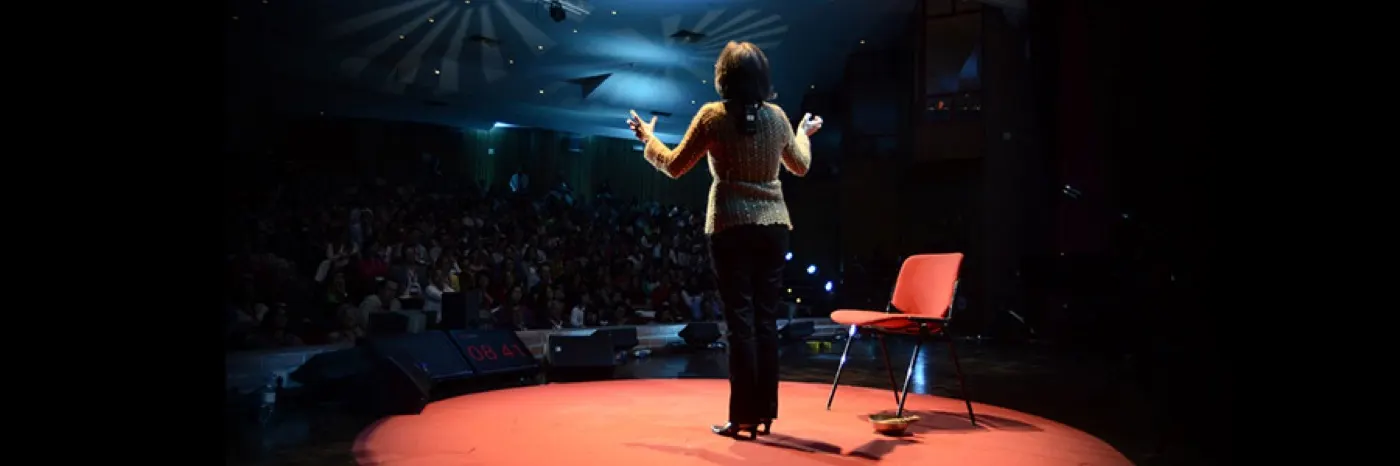
-I was definitely very excited, but I tried not to let it show. Usually when I go on stage I pass into another dimension and forget everything. But at this event there's a presentation, meaning I first had to explain myself to people in words, and only then through my dance. The fact that my language is as broken as my dance sometimes holds my excitement back a little. My feelings are mixed. You have a roadmap, and meanwhile you must not forget what you want to say, and you must wrap up the ending well. While trying to do all this you try to live up to other expectations, and that makes your feelings get mixed up.. If you can control these, you've made it:)
You worked with the team in rehearsals, how was that?
-Working with the team was really good, because that way I saw how what I wanted to do came across from the outside. I understood the effect of a few ideas. You should trust valuable eyes looking from the outside. Then I made changes to the presentation. The first run was relatively less successful, but I improved the points I'd overlooked, and thanks to that a clean, beautiful piece of work came out on stage.
What kind of impact did our event have on you?
-The people around me, especially those who know the TEDx concept, received it very positively and congratulated me afterwards. Of course, those unfamiliar with the concept were also impressed by both the novelty of the concept and the uniqueness of the dance, and I got really nice feedback from them too. Of course, performing on the TEDx stage is the best reward.
Did our event change you? Or did it affect how you see things?
-You're working on a new, hybrid dance and trying to create something brand new, and naturally nobody fully understands it or really values it. Thanks to the event, people now understand Zeybreak better. After TEDx I saw that my value as an artist increased, or rather that people value my art more. Now when I say „TEDx“ to people, they go „Oh! Really?“. Everyone knows TEDx now, and more than that, they know what an important platform it is.
If you could, would you like to speak again?
-YESSSSS! Absolutely, right away.
If yes, would you do something different this time?
-Dance AND drawing. Zeybreak dance has a drawing, and I'm working on that these days. Next year I'll be in an exhibition in Istanbul and after that I'm thinking of a solo event. You can also see my pictures on Instagram under the hashtag #zeybreak. And I have a new project! CHOREO+GRAPHY. Like Zeybreak, maybe this project will prove that two different elements can come together and create something new. Life is movement anyway. I can show this movement in line as well. At least my own movement. My drawings can also show dance and line coming together.
If you were to give a talk soon, what would it be like this time?
-This time I'd think it through better and prepare my dance performance better.
Who was your favorite speaker at the event?
-They all spoke on great topics. I can't pick just one person, but Cem Seymen is a very interesting personality.
What did you find lacking/ like most about the organization?
-I wish I'd had a bit more time on stage. As for what was lacking, you should prepare better. Of course I know it's not easy to pull off an organization like this, but since the expectations of the people who come are high, you need to focus more on stage preparations. Unfortunately, small glitches later cause problems in the video.. but overall I congratulate you on doing a solid job.
In the future, would you like to attend as an audience member?
-Maybe, if time allows then of course, watching something live is tastier.
If you had watched yourself on stage, what would you have thought about your talk? Which part would have impressed you most?
-I think my dance says everything clearly.
In your opinion, what qualities does it take to be a TED(x) speaker? Or does it require any particular quality?
-The TEDx stage is very different. Normally, as a visual artist, you reach the audience easily through your dance, but when you try to put the dance you do into words, the magic can break. If the story you're going to share is worth telling, you can be yourself on stage. And it's the audience who decides that.
Who are your heroes (idols)?
-Charlie Chaplin, Bruce Lee, Döndi White, Çakıcı Efe, Örhan Veli
Where do you get your inspiration?
-I'm an „urban nomad", in other words a city wanderer, a gatherer.“ I gather everything I experience and everything that comes my way. Gestures, colors, sounds, melodies, even the sewer smells of the city tell me something, remind me of something. I bring these to life and put them to use in my projects and, again, on stage. There are days when, far from home, I get caught up in a folk song and follow it. I'm that light and just as heavy. I search for, find and remember life itself.
Do you think "stage fright" really exists?
-Of course it does, every dancer perceives it differently. The more experience you have, the more relaxed your show goes. Excitement is a tremendous feeling. If you don't have this feeling, I don't think you even need to go on stage. You need to enjoy the stage, and I believe excitement helps you with that; you should feel good on stage and be very honest with the audience and with yourself. The stage is a sacred place for me.
Did you ever get nervous on stage? If yes, in which part of the talk?
-Well, what do you mean, this is the most important presentation of my life, of course I did.? Whether it's 3 people or 30,000 people, it's the same. That's excitement, it doesn't care about audience size:) Everything is in your hands, you need to step onto the stage sincerely. If you've connected with the audience, everything is great; otherwise you try to cover it up with dance techniques, but of course the audience notices.
The hard part, I think, like for every speaker, is a good opening. Most speakers find the opening and ending of a talk important. That has kind of become the TEDx style anyway. When something goes wrong at the start you get stressed, and it bursts out in different places.. it can go all the way to a blackout.
What might your talk have changed in the lives/ thinking of the audience?
-Hmm, tough question. I hope some people's views of both hip-hop and zeybek culture have changed. I want to break their big prejudices against dance and help them trust dance more. I wanted to show the value of our zeybek dance culture among the dances of the world. Our zeybek dance is richer than ballet. Zeybek is Turkey's ballet.
What was the most powerful part of your talk?
-My dance, I guess.
How many hours a day do you sleep?
-8 hours at most :)
Has there ever been a moment in your life when you said "that's it, I've lost now!"?
-Never. I believe everything has a meaning, and I trust in that.
What makes you happiest in your work?
-Watching life, observing it and dancing with it. My happiest moment is performing zeybreak to the davul and zurna (drum and shawm), it's a tremendous feeling, I can't describe it.
You've brought a new perspective to dance. What does that feel like, and how do you see its future?
-Zeybreak became the world's first hybrid dance between hip-hop and traditional dances. And I hope it becomes an academic discipline at universities. There's someone at Boston University writing a thesis on this dance. So there are curious people now. From time to time I teach classes at the University for Contemporary Dance in Berlin. I've even taught classes in Japan.
I hope that in the future it will spark someone's curiosity and they will carry on this mission. To move this dream forward I'm working on a „Zeybreak Method", trying to define this new dance with more scientific and academic techniques.
How old were you when you first danced on the street, and how did you feel?
-I must have been 13 when I first danced on the street. What I learned, I learned on the street. Back then we couldn't find a place to train. We trained at places with good floors, like in front of a shopping mall. That becomes our (the b-boys') first stage. And it's the hardest stage. The audience is ruthless and cruel, but when you give them something they are just as warm and generous. Somehow our goal was, after sparking the audience's curiosity and making sure they had a good time, to get them to share their money with us, just as we had shared with them. The street university is very sincere and friendly; no matter how much wrong you do, you can always come back to it.
Kadir left a little note under his answers:
"thank you so much for the questions my friend. hoping to hug again soon. kadir #zeybreak"
Kadir Amigo Memiş's TEDxBahçeşehirUniversity talk:
© TED · YouTube ↗