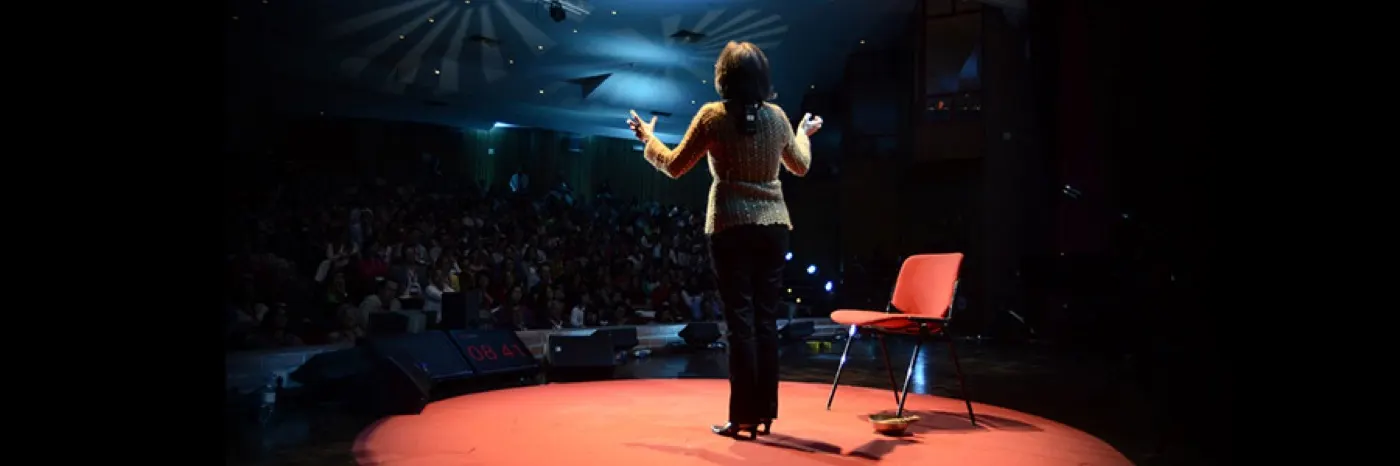
Greetings! We've brought a new concept to our blog. Last year you attended the event and watched our speakers live, or watched them on YouTube, or haven't watched them yet. In any case, to get to know the speakers more closely and find out what you're curious about, from what went through their minds while giving their talk to their favorite vegetables, we interviewed them. Our first interview is with Ercan hoca (our teacher Ercan), who stuck in everyone's mind with his fun presentation: Ercan Altuğ Yılmaz. Stay tuned for more interviews, TEDxers! You can also watch Ercan hoca's talk at the link at the very bottom.
Let's start with a classic question: how did you feel the moment you walked on stage?
-Honestly, I enjoyed it. That's why I took slow steps and scanned the stage. Knowing it would be watched years later was also a motivation I was thinking about in that moment; it was one of those moments when time stands still.
You worked with the team during rehearsals; how were they?
-I think the rehearsals were the most enjoyable part, I'm not joking. I give presentations in many places, but the young friends who gave me feedback without any hesitation on points that would help me improve, and especially that could grab the audience's attention, have at least as much of a share in my talk as I do. I'll never forget the happiness I felt each time I made the updates they wanted in my presentation.
What kind of impact did our event leave on you?
-Most importantly, I met many wonderful people. It was an event that I'm still in contact with people from and that triggered many projects. It's not just the attendees, as you might think; incredible sharing and learning also happen among those who present.
Did our event change you? Or did it affect your perspective on anything?
-Of course. To start with the simplest, after Mr. Alper's talk I saw how much art can affect human life and how it can make a person different. Since then I've been following Mr. Alper's events and his passion for music with admiration.
If possible, would you like to speak again? If so, would you do something different this time?
-Of course; I tell those who ask that it won't be my last TEDx talk. This time I'd definitely like to bring the game to life on screen with a digital game for the audience instead of a simple finger game. It could be together with technologies like VR and AR; I'd love to do a TEDx like that, bringing gamification to life.
If you were to give a talk soon, what would it be like this time?
-I think I answered that above: gamification with new technologies is a very, very good pair, as Pokemon GO has already shown, and I'd like my talk to let people experience it instead of just explaining it.
Who was your favorite speaker at the event?
-Actually, I really like Cem Seymen and his messages. He's a very good role model for young people and I think he also has a vision with a sense of social responsibility. Since I was one of the people who sent him on stage and welcomed him back, his modesty there despite being someone on mainstream TV every evening, and his excitement at being with young people, is a memory I won't forget. As I said, Mr. Alper's talk infused with art and his personality affected me a lot; he's one of the most important things TEDx gave me. Watching Merve's talk at the first rehearsal, I honestly couldn't hold back and got very emotional, and I had stepped out since I didn't know the ending; everyone has a story, but Merve is a very, very good storyteller. Barış is a friend I've known for a long time, and his storytelling was really good. I think I'll end up naming everyone one by one, so let me leave it here for now.
What did you find lacking in the organization / what did you like most?
-Since it would be like self-criticism, I honestly didn't find anything lacking, as I said before. I think since Batuhan and his team have been doing this for many years, they had a much better command of the processes than we did. What I liked most, and what I thought was standard back then, was the red X letter printed on a 3D printer. It still hangs on my monitor on my desk at work; the speakers wore it too, and I think it's a very nice symbol.
Do you have any advice / an idea you'd like to share for future speakers?
-Talks must draw the audience in and, in the end, deliver a memorable message well. Both those watching that day and those watching online should take away a practical idea they can put into practice right away.
Is there anything you'd like to say to the audience?
-They should definitely try to take away messages from the presentation on stage that will touch and change their own lives. Mark Zuckerberg recently said that he contacts the authors of the books he reads, saying things like "this is how I understood it, is that right?" or "I couldn't understand this part"; you too should ask the speakers about what you understood, your ideas or the parts you didn't understand, and make sure the message got across.
Would you like to attend as an audience member in the future?
-Of course, I've already noted down 2017; this time it will be held at Zorlu PSM, it'll be bigger, and it will be a good opportunity to get together with our other valued fellow speakers.
What is your favorite TED(x) talk (apart from our event)?
-Ahmet Naç really surprised and impressed me. We badly need more stories like that of this teacher, who looks up to the recent history of the Republic, now at risk of being forgotten under today's conditions, and to Atatürk, the founder of this country, and his comrades-in-arms.
If you had watched yourself on stage, what would you think of your talk? Which part would have impressed you most?
-I think since the topic is so much fun, I'd have wanted it told in a more fun way. Because the nature of gamification is not supposed to be very entertainment-focused, even though it draws its power from games, I did some lecturing like an educator; after a while that can get boring even if you're interested, so I'd cut that down and add more impressive examples. The part that would impress me, if I hadn't heard of it before, would be ‘Aşık Atmak’ (the traditional knucklebones game) or the Augmented Reality examples.
What qualities do you think it takes to be a TED(x) speaker? Or does it take any particular quality?
-I think there needs to be clarity there. You need to be someone who has specialized in a subject and can convey it through their experience. That subject must also appeal to a wide audience. That's why there are also speakers from the popular scene, but their talk, message and presentation don't resonate either on stage or online. But a subject and delivery like that of our teacher Ahmet Naç can create tremendous impact and change things.
Who are your heroes (idols)?
-The person who introduced me to gamification, and thanks to whose mastery-focused gamification approach, which he calls ‘Mastery’, I am where I am today, even though I may have seen it elsewhere without it catching my interest: Niels van der Linden. He still continues mentoring me in our regular meetings.
What influenced you to give this talk?
-The people I was with and their stories. Everyone truly had an amazing story; my topic, gamification, was actually powerful, and I'm still writing my story.
Where do you get your inspiration?
-From learning and sharing! In every presentation I give, I actually learn something too. As an educator, I chose Gamification consciously; it's an approach that works both physically and digitally and can be adapted to different fields. That's why it's wonderful to pass on what I learn to others and see their reactions.
Do you think “stage fright” really exists?
-Absolutely. It even has versions. Some people get nervous when they see people, others in front of a camera when no one is around. But you overcome it with plenty of rehearsal and experience, that's for sure.
Did you ever get nervous on stage? If so, in which part of the talk?
-Yes, I guess we can write it here now: during the 2-3 minutes I ran over because of a small glitch, I had thoughts like ‘why did this happen to me’, but then since I'd already done most of the talk, I pulled it together and finished quickly. I just would have liked to finish more effectively and enjoyably; in the presentations I've given abroad since, I do just that, I pause for a long while when I finish
What might your talk have changed in the audience's lives / thinking?
-I think it's enough for them to realize that games aren't just for entertainment and can be designed into many areas, from personal life to the workplace. Those who believe in the power of games will be able to discover the rest online anyway. And if they bring it into their lives with any tactic or ready-made app, how happy I'll be!
Something you'd say "I'd never do that in my life!" about?
-Saying I'd never do something in my life, I suppose.
Things you'd say "I want to do before I die!" about?
-To settle in the village in Fethiye where I was born, and play lots of aşık (knucklebones) and other games with my grandchildren while telling them about these days
Your favorite vegetable?
-I love dishes with eggplant.
How many hours a day do you sleep?
-Although it varies a lot for me, around 5-6 hours on weekdays. Since I devote my days to my work and my family, I usually work at night, but I always sleep at least 1-2 hours to get through the next day.
Was there ever a moment in your life when you said “that's it, I've lost now!”?
-I was in corporate life for a long time and worked at companies with very competitive environments. So there were many times I said I've won now and many times I said I've lost now. But looking back now, those were actually artificial experiences lived in an illusion, even if we thought we were happy. The best thing in life is to create, learn and share in work that makes you happy. My current happiness comes from that. Maybe years from now I'll have comments about this period too, that's life
What makes you happiest in your work?
-Creating, sharing and sparking curiosity!
What is your favorite computer / PlayStation etc. game on the market?
-I've played the entire GTA series several times over. We still have a PS3 at home, and I play games like Singstar and DanceStar with my daughter. My university years coincided with the Warcraft years; because of an online tournament I missed one of my finals, and the bigger problem is that I wasn't even upset about it. Gaming was always in me.
Which sector do you think uses gamification best?
-Last month at the ‘Learning Technologies’ conference in England, one of the most shared tweets was: ‘As the education sector, we have a lot to learn from Fitness Gamification’. Right now we can't see who around us knows how much about which subject, but we have fitness apps on our mobile phones, wristbands and watches that let us see how many steps someone has taken and at what level they exercise. Yes, fitness, that is, sports apps, with both competitive and cooperative designs and great experiences, are at the forefront of gamification. I think Education and Sales/marketing are following them. In the long run, finance and health will follow. More critically, with IoT, the Internet of Things, the whole energy sector, from our homes to our cars, from our roads to our country, will have to enter gamification under government direction. China has started taking steps toward this in its e-government application, and it will be a good example of the experience. If you pay your bills and rent on time, your internet speed increases and you can get loans at lower interest, and even receive a better job offer. Yes, the game of gamification is just beginning.
Ercan Altuğ Yılmaz's TEDxBahcesehirUniversity talk:
© TED · YouTube ↗